What Builders Want From Building Product Manufacturers in an Affordability-First Market | Marketer Craft | Kyle Rhine
Building product manufacturers spend a lot of time thinking about contractor loyalty.
How do we get contractors to try our product? How do we get them to switch from a competitor? How do we build preference? How do we keep them loyal once we've earned their business?
Those are important questions, but they can lead marketers toward the wrong answers if we think about contractor loyalty the same way we think about consumer brand loyalty. A contractor isn't choosing between two pairs of shoes or deciding which coffee shop they prefer. They're choosing a product they may have to purchase, transport, install, stand behind and potentially come back to fix if something goes wrong.
That changes the relationship considerably.
For contractors and installers, product choice isn't just a brand decision. It's a business decision, and every experience with the product creates another piece of evidence about whether choosing it again is worth the risk.
That's why manufacturers trying to build contractor preference need to understand something fundamental: the product doesn't just have to perform when the job is finished. It has to perform throughout the contractor's entire experience with it.
How do contractors choose building products?
Contractors evaluate building products based on a combination of product performance, availability, price, installation experience, familiarity, manufacturer support, customer demand and the likelihood that the product will create problems after the job is complete.
The exact balance varies considerably by category. A roofer choosing shingles, a plumber selecting a water heater and a remodeler recommending windows aren't making identical decisions. Neither are a one-person operation and a contractor running multiple crews across dozens of projects.
But the underlying calculation is similar.
Can I trust this product to help me complete the job successfully and profitably?
That's a much more useful starting point for contractor marketing than asking how to generate more awareness.
1. Familiarity has value
Marketers love novelty. Contractors often have good reasons to be skeptical of it.
A contractor who has installed the same product dozens or hundreds of times knows how it behaves. They know which tools they need, how long installation takes, where problems tend to occur and what shortcuts not to take. Their crews may already be trained on it, and they have some idea of how the manufacturer will respond if something goes wrong.
Switching products introduces uncertainty into that system.
The competing product might claim better performance or offer an attractive new feature, but the contractor also has to learn how it installs, understand its quirks and determine whether the manufacturer will actually support them. If the benefit of switching isn't meaningful enough to compensate for that uncertainty, sticking with the familiar product is a rational business decision.
Manufacturers trying to convert contractors therefore need to answer more than Why is our product better?
They need to answer Why is switching worth it?
That might mean meaningfully faster installation, better availability, fewer callbacks, stronger margins, better homeowner demand or technical support that makes the contractor's job easier. Whatever the advantage is, it needs to be important enough to overcome the value of familiarity.
2. Installation is part of your product
A manufacturer may define its product by what leaves the factory. The contractor's definition is broader.
To them, installation is part of the product experience. If something is awkward to handle, requires additional steps, uses unfamiliar tools, has unclear instructions or creates opportunities for mistakes, those aren't simply installation issues. They're characteristics of the product. And right now, labor efficiency matters.
The construction industry continues to face persistent labor shortages, while remodelers are also absorbing higher labor costs. Qualified Remodeler's Q2 2026 U.S. Remodeler Index reported labor costs approximately 10% higher than the previous year among surveyed remodelers. NAHB's broader housing outlook has also pointed to hundreds of thousands of construction job openings and an ongoing need to add workers simply to offset industry growth, retirements and departures.
In that environment, a product that saves installation time can create real economic value.
But manufacturers need to get more specific about it.
"Easy to install" is one of those claims that appears everywhere in building products and communicates almost nothing. What does easier actually mean? Does it eliminate a step? Require fewer fasteners? Reduce measuring or cutting? Allow one installer to do something that previously required two? Make training new employees easier? Reduce mistakes?
If installation is genuinely an advantage, quantify it whenever possible.
Time saved is money saved. Complexity removed is risk removed.
Those are contractor benefits.
3. Availability can beat preference
A contractor can't install the product they can't get.
That sounds painfully obvious, but manufacturers sometimes treat distribution and marketing as separate conversations. The marketing team builds preference while sales and operations worry about where the product is stocked.
The contractor experiences all of it as one brand.
If they have to drive 45 minutes to find your product, wait a week for an order or repeatedly substitute something else because their preferred distributor doesn't carry enough inventory, you've created a reason for them to develop a relationship with another brand.
Availability becomes especially important because contractors often don't have complete control over timing. Jobs change. Materials get damaged. Homeowners add scope. Crews move faster or slower than expected. Something that wasn't needed until Thursday suddenly becomes necessary Tuesday afternoon.
In those moments, the product sitting at the local dealer has a considerable advantage over the product with the better campaign.
This is why strong contractor marketing and strong distribution strategy need to work together. Creating demand without making the product reasonably accessible can actually create frustration rather than preference.
4. Contractors are protecting themselves from callbacks
A product failure doesn't end when the manufacturer processes a warranty claim.
The contractor may still have to answer the homeowner's call, schedule another visit, send someone back to the job, remove the failed product, install the replacement and explain why something the customer paid for didn't work.
Even when the manufacturer covers the material, the contractor can still lose time, money and trust.
That's why reliability matters differently to contractors than it does to many other audiences.
A product that performs consistently helps protect their reputation. A product that creates recurring problems puts that reputation at risk.
This is also why manufacturers should be careful about viewing warranties as the complete answer to product risk. A strong warranty matters, but the contractor would usually rather never use it.
The better question is whether your entire product and support system reduces the contractor's exposure to problems in the first place. Product quality, packaging, installation instructions, training, technical support and the way claims are handled all contribute to that experience.
The contractor isn't just buying your product. They're putting their name behind it.
5. Support matters most when something isn't normal
Most jobs probably don't require a call to the manufacturer.
The difficult ones are where the relationship gets tested.
Maybe the application is unusual. Maybe something on the jobsite doesn't match the drawings. Maybe the contractor encounters a condition they haven't seen before or needs an answer before the crew can continue.
At that moment, the value of manufacturer support becomes very tangible.
Can the contractor quickly find an answer online? Can the distributor help? Is there a knowledgeable rep available? Can technical support provide a useful answer without sending the contractor through three departments?
Manufacturers often evaluate customer service through internal metrics like response time and case closure. Contractors experience it much more simply:
Did you help me keep the job moving?
That's the standard that matters.
Those interactions also provide manufacturers with valuable marketing intelligence. If contractors repeatedly call with the same question, there's probably a content, training, documentation or product-design opportunity hiding inside it.
Good support solves today's problem.
Great organizations use those problems to prevent tomorrow's.
6. The homeowner can influence the decision, but not always the way marketers think
Building product manufacturers naturally want homeowners asking for their brands by name. In some categories, that consumer demand can create significant pull through the channel.
But contractors often have substantial influence over the final decision, particularly when homeowners don't have a strong existing preference or don't understand meaningful differences between products.
That influence has been earned through experience.
The homeowner may replace a roof once or twice in their lifetime. The roofer may install hundreds every year. A homeowner might buy windows once. The contractor has seen which products arrive damaged, which ones install cleanly, which manufacturers provide good support and which products tend to generate callbacks.
That expertise carries weight.
Current remodeling conditions make that recommendation even more important. Qualified Remodeler's Q2 research found that one-third of remodelers were seeing customers shift toward lower-grade or lower-priced products as cost pressures increased. Material quality, durability and brand reputation were among the attributes homeowners were most willing to sacrifice to reduce costs.
That creates an interesting challenge for manufacturers. You may need to create consumer demand while simultaneously giving the contractor a compelling reason to defend your product's value when the homeowner asks for something cheaper.
Those are two different marketing jobs and the strongest brands do both.
7. Don't mistake loyalty programs for loyalty
Contractor loyalty programs can work.
Points, merchandise, rebates, training, leads, preferred status and other incentives can all give contractors reasons to engage more deeply with a manufacturer. Brands continue to invest in them; Rinnai, for example, introduced a new installer loyalty program in 2026 that rewards plumbers and HVAC contractors for installing and registering eligible products.
But there's an important distinction marketers shouldn't lose: A loyalty program can reward loyalty. It can't manufacture it.
If the product is difficult to install, frequently unavailable or poorly supported, another branded polo shirt or a hat isn't going to fix the underlying problem.
The strongest contractor programs build around an already compelling product experience. Training makes installers more confident. Rewards recognize valuable customers. Leads help contractors grow their businesses. Technical resources make jobs easier. Communities create stronger relationships with the brand.
Those things can reinforce preference because they're providing actual value.
The program shouldn't be a substitute for it; it should be part of the larger offering.
8. Give contractors a reason to switch — and a reason to stay
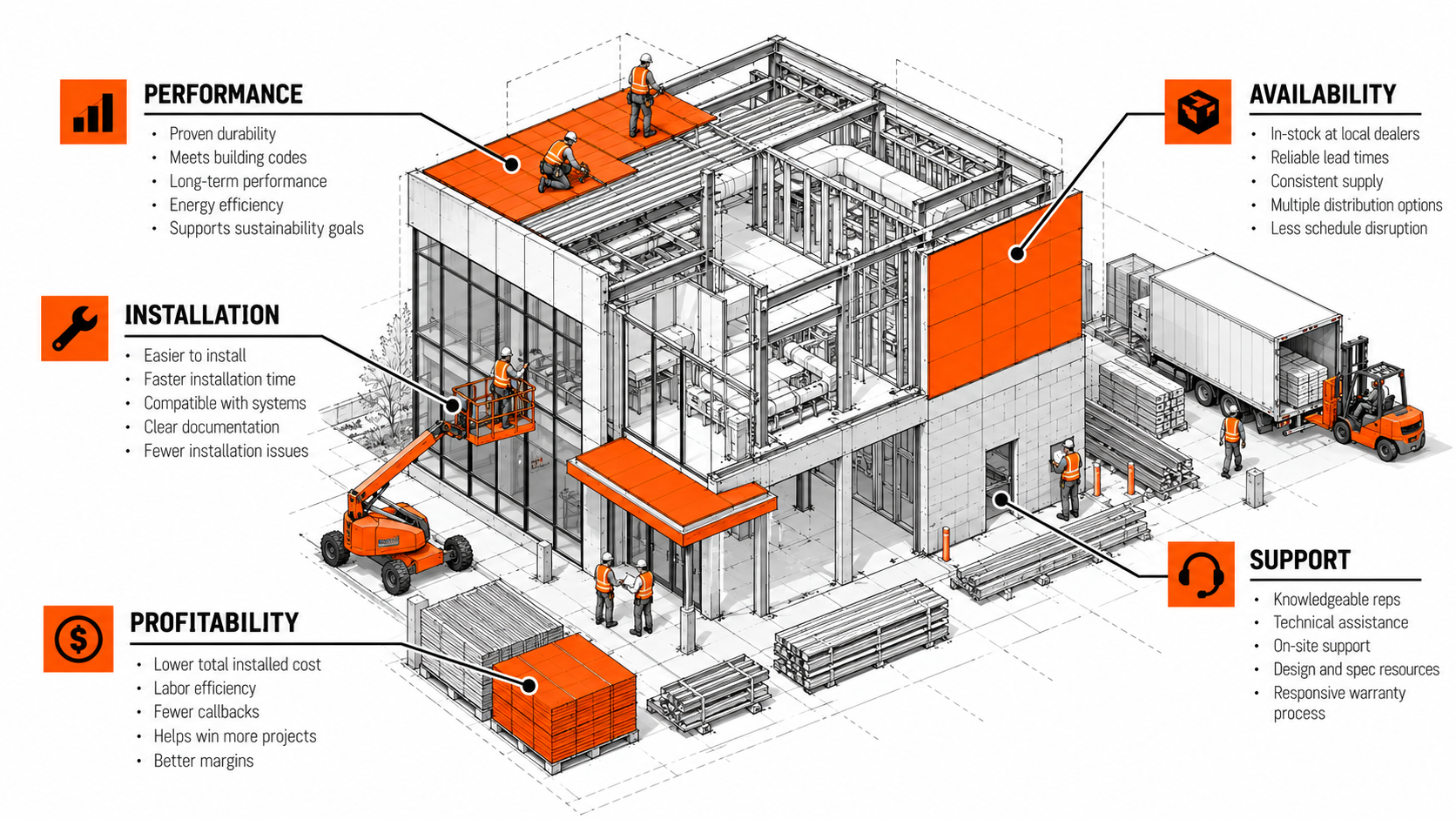
If you're trying to build contractor preference, I'd evaluate the experience across five areas.
PERFORMANCE: Does the product consistently do what it's supposed to do, and does the contractor trust it enough to put their reputation behind it?
INSTALLATION: Does the product make the job easier, faster or more predictable for the people actually installing it?
AVAILABILITY: Can contractors reliably get what they need, where they need it and when they need it?
SUPPORT: Can they quickly get useful answers, training and help when something doesn't go according to plan?
PROFITABILITY: Does using the product help the contractor make money through better margins, greater efficiency, fewer callbacks, stronger close rates or some combination of those benefits?
Manufacturers don't necessarily need to dominate every one of these dimensions. But they should understand where they're genuinely better and whether that difference is meaningful enough for a contractor to change behavior.
Because switching brands creates its own cost. Your advantage has to be worth it.
Contractor loyalty is earned on the jobsite
There's a reason contractor preference can be difficult to change. It's built through repetition.
Every installation that goes smoothly adds confidence. Every order that's available when needed reinforces the relationship. Every technical question that gets answered quickly builds trust. Every job completed without a callback gives the contractor another reason to make the same choice next time.
The reverse is also true.
That's why manufacturers shouldn't treat contractor marketing primarily as a communications challenge. Awareness matters. Advertising matters. Content, training, promotions and loyalty programs can all play a role.
But ultimately, your marketing promise has to survive contact with the jobsite.
Contractors choose products that help them get the work done, protect their reputation and run a profitable business. Manufacturers that understand that have a much better chance of becoming the brand contractors don't just try once, but choose again and again for their jobs.
Frequently Asked Questions
-
Contractors commonly consider product performance, installation experience, availability, price, familiarity, technical support, homeowner demand and the likelihood of callbacks or warranty issues. Because contractors often install the same category repeatedly, previous experience with a product can have a particularly strong influence on future decisions.
-
Contractors are more likely to consider switching when another product offers a meaningful improvement in areas such as installation time, availability, performance, profitability or support. Because switching introduces uncertainty and may require crews to learn a different product or process, small feature differences may not be enough to change established behavior.
-
Contractor loyalty is built through consistent product performance, reliable availability, an efficient installation experience, useful training and technical support and a relationship that helps the contractor operate more successfully. Rewards and loyalty programs can reinforce that relationship, but they generally cannot compensate for a poor underlying product experience.
-
Installation affects labor cost, scheduling, training, jobsite productivity and the likelihood of mistakes. With skilled labor remaining a significant constraint across construction and remodeling, products that demonstrably reduce installation time or complexity can create meaningful economic value for contractors.
-
Availability can be critical because contractors operate around job schedules and often need materials on relatively short notice. A preferred product that is consistently difficult to source creates delays and uncertainty, potentially giving more readily available competitors an opportunity to earn the contractor's business.