What Builders Want From Building Product Manufacturers in an Affordability-First Market | Marketer Craft | Kyle Rhine
There has never been a shortage of things building product manufacturers want builders to know about their products.
Better performance. Better technology. More design options. Improved durability. New features. Better warranties. The list goes on.
The problem is that builders aren't evaluating those benefits in isolation. They're trying to build a home someone can afford to buy while managing higher material costs, expensive land, persistent labor challenges, financing costs and buyers who have become increasingly sensitive to the final price of the home.
That makes the context around your product every bit as important as the product itself.
In September 2026, the NAHB/Wells Fargo Housing Market Index fell to 32, its lowest level since September 2025. NAHB pointed to higher mortgage rates, tight lending conditions, rising land, labor and construction costs and persistent labor shortages as major headwinds facing builders.
For building product manufacturers, there's an important lesson buried in those numbers.
If your customers are under pressure to make the economics of building a home work, your value proposition needs to help them do it.
Builders aren't just buying products. They're managing an equation.
It's easy for manufacturers to think about a builder as a customer buying windows, roofing, siding, insulation, decking, plumbing fixtures or any number of other products that go into a home.
That's technically true, but it's an incomplete way to look at the relationship.
Builders are assembling hundreds of products, dozens of trades, land, financing and labor into a finished home that ultimately has to be sold to a customer at a price that works for both sides. Every product decision becomes one variable in that much larger equation.
And right now, that equation is difficult.
NAHB's 2026 builder survey found that 65% of builders expected high interest rates to remain a significant problem during the year, while 62% cited the cost or availability of developed lots, 61% cited labor and 56% cited building material prices.
Those pressures don't exist independently of product selection. They shape it.
A product that costs more may still create value if it significantly reduces installation time. A premium exterior product might make sense if buyers can immediately see its value and are willing to pay for it. A technically superior product becomes less attractive if inconsistent availability creates scheduling problems across multiple communities.
That's why manufacturers need to stop thinking only in terms of product value and start thinking about builder value.
They're not necessarily the same thing.
1. Understand the cost pressure before talking about price
Price has always mattered in homebuilding, but affordability pressure makes it tempting for manufacturers to assume that builders simply want cheaper products.
That's too simplistic.
NAHB reported in August that builders experienced a median 6.7% increase in material costs for the same house over the previous year. The impact wasn't evenly distributed, either. Builders producing five or fewer homes experienced a median increase of 9.1%, compared with just 1.8% among builders producing 100 or more homes. Larger builders can have advantages in purchasing, supplier relationships, contracting and their ability to stock materials that smaller operators simply don't have. National Association of Home Builders
That distinction matters for marketers.
A national production builder, regional builder and local custom builder may all technically be "builders," but they aren't buying the same way or solving the same business problem. Their purchasing power, internal resources, construction processes, customer expectations and ability to absorb price increases can be very different.
So before developing another message around "competitive pricing," understand where your product actually creates economic value for the type of builder you're trying to reach.
Sometimes that will be acquisition cost.
Sometimes it won't.
2. Think about total installed cost, not just product cost
One of the most important distinctions building product marketers can make is between product cost and installed cost.
A less expensive product isn't necessarily less expensive once it reaches the jobsite.
If another product can be installed faster, requires fewer people, reduces callbacks, creates less waste, simplifies training or lowers the likelihood of installation errors, the economics can change quickly. That's particularly relevant in a market where labor remains a persistent problem: 61% of builders surveyed by NAHB expected labor cost or availability to be a significant issue in 2026.
This creates an opportunity for manufacturers, but only if they can prove the benefit.
"Easy to install" isn't enough.
How much easier?
Can one installer complete the work instead of two? Can a crew install 20% more product in a day? Does the system eliminate a step? Does it require fewer specialized tools? Does it reduce the likelihood of rework?
Those are much stronger value propositions because they connect product design to something the builder can actually measure.
A useful way to think about the value equation is:
Product Cost + Labor + Time + Waste + Risk = Total Installed Cost
If your product creates an advantage somewhere in that equation, that's probably more meaningful to the builder than another paragraph about features.
3. Reliability has economic value
Availability became a major industry conversation during the supply-chain disruptions of the early 2020s, but it's easy to assume that conversation is over.
For builders, reliability never stopped mattering.
A product arriving late can affect more than one line item. It can disrupt a trade schedule, delay the next phase of construction, extend carrying costs and create a chain reaction across the project. Multiply that across dozens or hundreds of homes and what looks like a product availability issue becomes an operational problem.
That means manufacturers should think about reliability as part of their value proposition rather than treating it as a logistics issue that sits somewhere outside marketing.
If your organization has strong fill rates, dependable lead times, regional inventory, reliable distribution or systems that give builders better visibility into availability, those things have value.
The same applies to consistency. Builders operating across communities don't necessarily want to solve the same product problem over and over again. They want products, partners and processes they can trust to perform repeatedly.
In a complicated market, predictability is a benefit.
4. Help builders address the labor problem
The construction labor shortage isn't a new issue, but its persistence should change how manufacturers think about product development and marketing.
If labor is scarce and expensive, products that reduce the amount of skilled labor required to complete a job become more valuable. So do products that are easier to learn, easier to install correctly and less likely to create callbacks.
This is where manufacturers need to look beyond their immediate buyer and understand the people actually interacting with the product on the jobsite.
What does the installer think?
Where do mistakes happen?
Which installation steps consume the most time?
What frustrates the crew?
What causes callbacks?
What requires the most training?
Those questions aren't simply useful for product development. They're marketing questions because the answers can uncover benefits that are far more relevant to builders than the features manufacturers traditionally promote.
If your product genuinely saves labor, don't bury that advantage halfway down a technical data sheet.
Build the story around it.
5. Remember that the builder still has to sell the home
Manufacturers sometimes spend so much time thinking about selling to the builder that they forget the builder has another sale to make.
The home.
That matters even more when affordability is putting pressure on demand. Sales of new single-family homes increased in August, but remained 2% below the prior year's pace. The median new-home sales price fell 5% year over year to $393,700, reflecting builder incentives and movement toward lower price points.
Earlier in the year, NAHB reported that 64% of builders were using sales incentives and 37% were cutting prices as they worked to address affordability challenges. Builders were also adapting home design through flexible spaces and features that buyers increasingly value.
Manufacturers need to understand where their products fit into that sales conversation.
Some products are largely invisible to the homeowner but create significant performance or operational value for the builder. Others can become part of the reason a buyer chooses one home over another.
Know which one you are.
If your product is visible, experiential or easily understood by consumers, help builders communicate its value. Give sales teams simple language. Provide useful visuals. Explain the benefit in terms a homeowner actually cares about. Create showroom, model-home and digital tools that help buyers see the difference.
Don't hand a builder a product brochure written for an architect and expect their salesperson to translate it.
Sales enablement should extend all the way through the channel.
6. Don't confuse more features with more value
Product teams love features because features are tangible. They're easy to put into presentations, comparison charts and launch materials.
But every additional feature doesn't automatically create additional value.
In an affordability-constrained market, manufacturers need to be disciplined about understanding which features builders and homebuyers are actually willing to pay for.
NAHB's 2026 research provides a good example of how builders are adapting. Half reported using flex or multipurpose rooms, 57% were adding drop zones and 40% were incorporating EV charging stations as they responded to changing buyer preferences. Builders were also looking for ways to expand usable living space through patios, porches and decks.
The lesson isn't that every manufacturer should suddenly develop an EV-related product.
It's that builders are constantly making tradeoffs between cost and perceived value.
Manufacturers should be doing the same thing.
Voice-of-customer research becomes particularly important here. Instead of asking builders whether they "like" a feature, find out whether it meaningfully affects product selection, construction efficiency or the homeowner's willingness to pay.
Those are much harder questions.
They're also much more useful.
7. Make it easier to do business with you
Manufacturers naturally spend a lot of time thinking about the product itself, but builders experience far more than the product.
They experience your sales team, distributors, ordering process, lead times, product information, technical support, warranty process and response when something goes wrong.
All of that becomes part of the brand.
A great product paired with a difficult ordering process isn't a great experience. Neither is a strong product backed by poor technical support, inconsistent availability or a warranty process that takes weeks to resolve.
For builders managing multiple jobs, communities and trade partners, complexity has a cost.
Manufacturers should therefore ask a broader question than How can we make our product better?
Ask:
How can we make working with us easier?
That might lead to improvements in product availability, estimating tools, ordering, technical resources, training, warranty claims or communication between your team and the builder.
None of those improvements may sound as exciting as launching a new product.
They may create more value.
8. Stop selling features. Start solving builder problems.
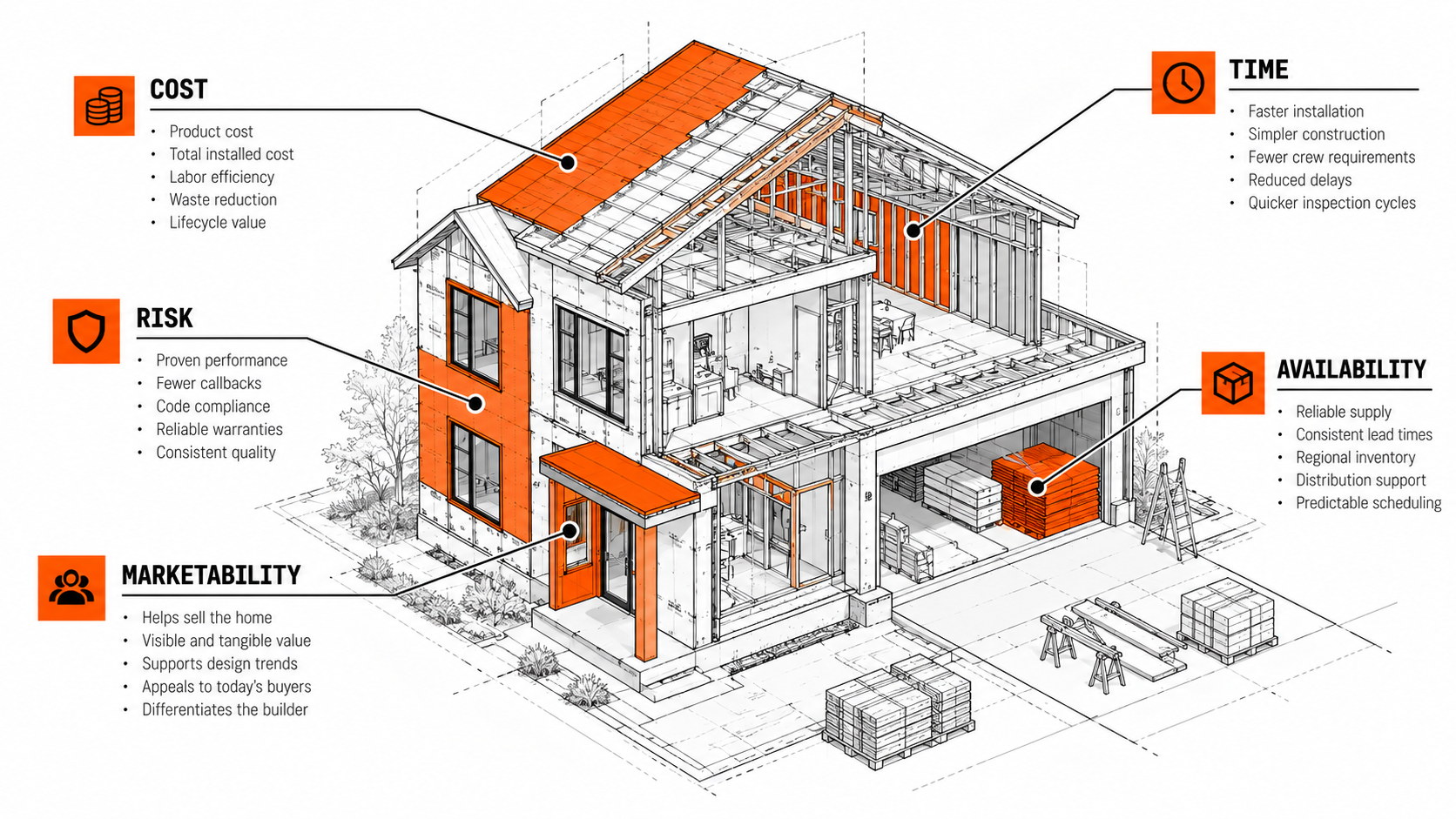
There's a simple framework I'd use when evaluating a building product's value proposition for builders.
COST: Does the product help the builder control product, labor or lifecycle costs?
TIME: Does it install faster, simplify construction or reduce delays?
RISK: Does it improve reliability, reduce callbacks or make performance more predictable?
AVAILABILITY: Can builders consistently get the product where and when they need it?
MARKETABILITY: Does the product help the builder create a home buyers value and are willing to pay for?
Not every product needs to win in all five areas and it probably shouldn't try. The important thing is knowing where your product creates meaningful value and being able to prove it.
A manufacturer that saves a builder two hours of installation time shouldn't hide behind a generic "innovative design" message. A product that significantly reduces callbacks should quantify that advantage. A premium product that helps sell upgrades should give the builder tools to make that value obvious to the homeowner.
The closer marketing gets to the builder's actual business problem, the stronger the value proposition becomes.
The best manufacturers understand what builders are trying to accomplish
The building industry doesn't need another product with a longer feature list.
Builders need to deliver homes people want at prices they can afford while managing labor, materials, schedules, risk and an increasingly difficult economic environment. Builder confidence stood at just 32 in September, material costs continue to rise and affordability remains a significant constraint on demand.
That should change the way manufacturers market to them.
Start with the builder's economics. Understand how your product affects labor, time, risk, availability and the marketability of the finished home. Then build your positioning around the places where you can genuinely make the builder's job easier or their business stronger.
Because in an affordability-first market, better isn't enough. Better has to create value somewhere.
Frequently Asked Questions
-
Home builders consider much more than product performance. Cost, labor requirements, installation time, availability, reliability, warranty support, buyer demand and the risk of delays or callbacks can all influence product selection. The relative importance of each factor varies significantly between production, regional, custom and smaller builders.
-
Manufacturers should connect product benefits to the business problems builders are trying to solve. Instead of focusing primarily on features, marketing should explain how a product can affect total installed cost, labor efficiency, construction time, reliability, availability, risk or the marketability of the finished home.
-
Purchase price represents only one part of the cost of using a building product. Labor, installation time, waste, specialized tools, training, rework and callbacks can make a lower-priced product more expensive in practice. Manufacturers that can demonstrate savings across the complete installation process have a stronger value proposition.
-
Persistent labor shortages increase the value of products that can be installed faster, require fewer workers, reduce the need for specialized skills or lower the likelihood of installation errors and callbacks. NAHB's 2026 survey found that 61% of builders expected labor cost or availability to be a significant problem during the year.
-
It depends heavily on the product category. For visible or experiential products, homeowner awareness and preference can help builders differentiate homes, sell upgrades or justify additional cost. For products homeowners rarely see or understand, operational benefits such as performance, labor savings, reliability and risk reduction may be more important.