How Architects Choose Building Products: What Manufacturers Need to Know | Marketer Craft | Kyle Rhine
Architects have no shortage of building products to choose from.
In many categories, they have dozens of manufacturers competing for attention, each making similar claims about performance, innovation, quality and service. For building product manufacturers, that means getting specified isn't simply a matter of having a better product, getting in front of more architects or creating another beautiful marketing brochure.
It's about making your product easier to understand, easier to evaluate and ultimately easier to specify.
That distinction matters because architects sit at an important point in the building products decision process. They research products, evaluate alternatives, establish performance requirements and often influence which manufacturers make it into a project long before someone places an order. Recent research from the American Institute of Architects reinforces just how central architects remain to product and material selection. AIA's 2026 Architect's Journey to Specification examines how architects research products, interact with manufacturers, approach sustainability and make specification decisions.
For building product manufacturers, the opportunity isn't simply to market harder. It's to better understand how architects make those decisions and remove as much friction as possible along the way.
How do architects choose building products?
Architects evaluate building products through a combination of project requirements, product performance, technical information, previous experience, manufacturer support, availability, risk and increasingly sustainability considerations. They aren't simply asking whether something is a good product. They're asking whether it's the right product for this particular project, application and set of requirements.
That might sound like a small distinction, but it's an important one. A product can perform exceptionally well and still lose the specification because the architect can't quickly find the information needed to evaluate it, isn't confident it satisfies the project's requirements or believes another manufacturer will be easier to work with.
That's why marketing to architects has to extend well beyond awareness. Manufacturers need to help architects move from discovering a product to confidently putting it into a project.
1. Start with the project, not the product
Building product marketing naturally starts with the product. Manufacturers spend years developing products, improving performance, creating proprietary technologies and finding ways to differentiate themselves from competitors, so it's understandable that those things become the center of their marketing.
Architects usually start somewhere else. They start with the project.
They have a vision to bring to life, performance requirements to meet, codes to satisfy, budgets to consider, clients to serve, systems to coordinate and schedules to manage. Your product enters somewhere in the middle of all of that, which means the things your organization is most excited to talk about aren't necessarily the things an architect is trying to understand when they encounter your product.
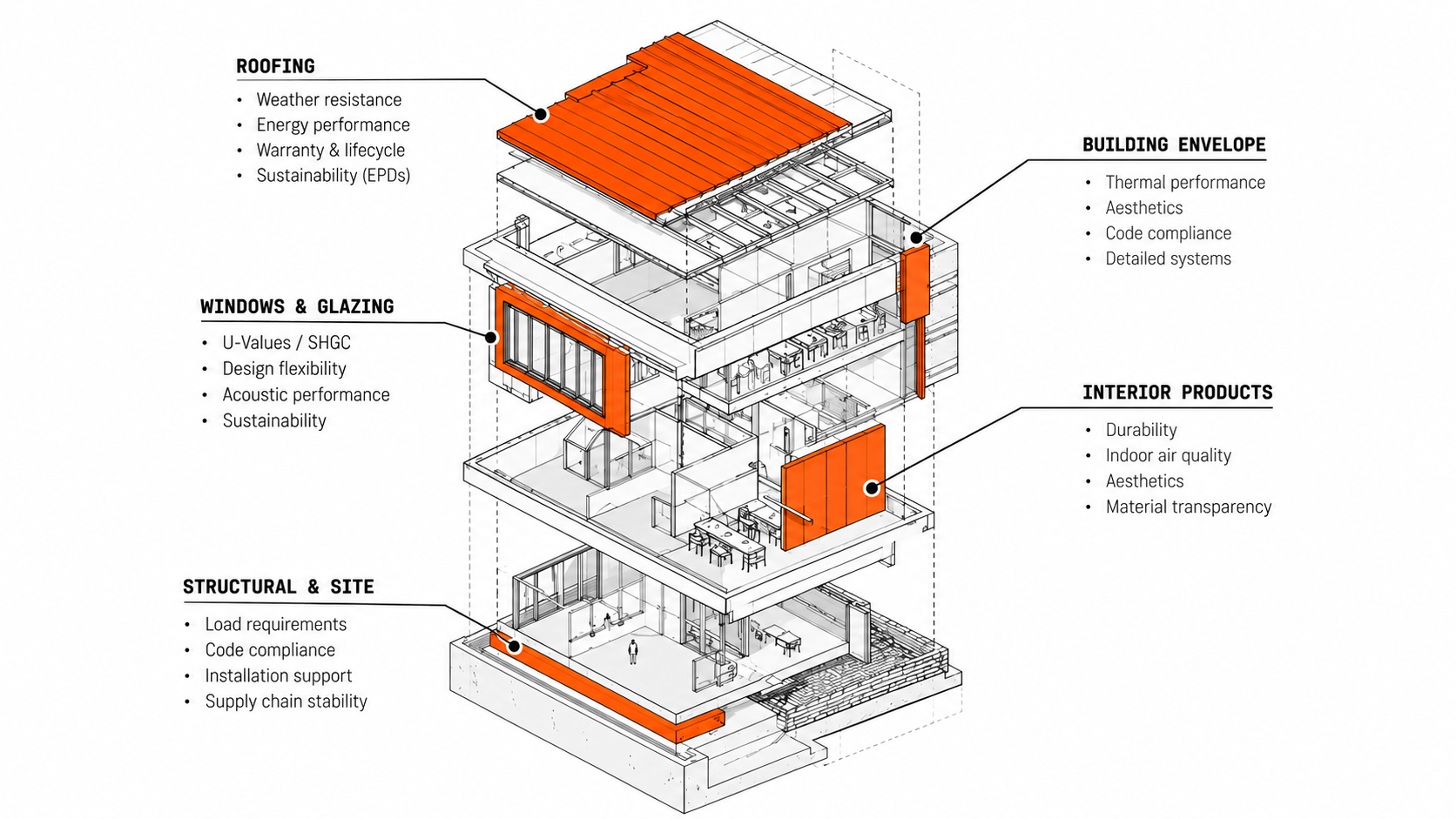
A roofing manufacturer, for example, might want to lead with its membrane technology or manufacturing process. The architect may be thinking about drainage, energy performance, fire ratings, warranty requirements, detailing and how the roof interacts with the rest of the building envelope. A window manufacturer may want to talk about product design or proprietary features, while the architect is trying to meet thermal-performance requirements, achieve a specific aesthetic and stay within the project's budget.
The strongest building product marketing connects those two worlds. Instead of beginning with What do we want architects to know about our product?, start with a more useful question: What problem is the architect trying to solve when they encounter our product category?
2. Make technical information ridiculously easy to find
There is a tendency in marketing to treat technical information as something separate from marketing. For architects, technical information often is the marketing because it's what allows them to move from interest to evaluation.
Product data, specifications, CAD and BIM files, performance testing, code information, installation details, material documentation, warranty information and sustainability documentation aren't simply supporting materials that should be buried several clicks into a website. They're an important part of the product experience.
AIA's MasterSpec and Specpoint ecosystem, for example, contains more than 50,000 product listings designed to help architects and engineers research manufacturers and select products for specifications. That should tell manufacturers something important: architects are actively looking for structured, reliable product information.
If yours is difficult to find, incomplete, inconsistent or outdated, you've introduced friction into the specification process. Every additional search, unanswered question or missing document gives another manufacturer an opportunity to become the easier choice.
A useful exercise is to approach your website as an architect who has never interacted with your company before. Could they understand where your product fits, find the relevant performance information and access the technical resources they need without calling someone for help? If the answer is no, that's not simply a website problem. It's a marketing problem.
3. Understand that specification is also a risk decision
Marketers naturally focus on upside. We talk about better performance, improved aesthetics, new technology, greater efficiency and all the reasons someone should choose our product.
Architects also have to think about the downside.
They need to consider what happens if the product doesn't perform as expected, availability becomes an issue, installation becomes difficult, documentation turns out to be incomplete or the product creates an unexpected problem on the jobsite. When an architect specifies a product, they're putting their professional judgment behind that decision.
That makes trust enormously important. Previous experience matters. Clear documentation matters. Testing matters. References matter. Manufacturer reputation matters. Access to knowledgeable technical support when something doesn't go according to plan matters.
This is one reason a lesser-known product with a compelling new feature doesn't automatically replace an established manufacturer. The new product isn't simply competing feature against feature. It may also have to answer a much harder question: Why should the architect introduce additional uncertainty into the project by choosing you?
Building product marketers need to understand that risk is part of the value equation and give architects enough evidence, information and support to feel confident in the decision.
4. Don't underestimate the manufacturer representative
Digital marketing matters enormously in product discovery and research, but that doesn't make the human side of specification any less important. AIA's latest specification research specifically examines what architects value in manufacturer representatives and manufacturer relationships, reinforcing the continued importance of knowledgeable people throughout the process.
That makes sense when you consider the complexity of many building products. An architect may need help evaluating an assembly, understanding a performance requirement, locating specific documentation or determining whether a product is appropriate for an unusual application. A knowledgeable architectural representative can shorten that process considerably and provide something a website can't always provide: context.
The mistake manufacturers make is treating the representative and the marketing program as two separate systems. They should reinforce each other. Marketing creates awareness and gives architects useful information before and after a conversation. Representatives provide expertise, context and confidence. Digital tools make information available when the representative isn't there, while representatives hear the questions, objections and problems that should influence future marketing content.
The best programs create a feedback loop between all of them.
5. Product innovation works better when architects are part of the conversation
One of the more interesting findings from AIA's 2026 research is that 73% of architects say they highly value being involved in manufacturers' product-development efforts, yet only 24% say they actually want to participate directly.
That gap is worth paying attention to because it suggests architects want manufacturers to understand their needs, but that doesn't necessarily mean they want to join a six-month product-development committee or spend hours reviewing concepts.
There's a lesson for marketers: listen earlier.
Conduct interviews before developing the launch plan. Build a small architect advisory group. Talk with specifiers about where current products fall short. Ask why certain products get eliminated from consideration. Learn which pieces of technical documentation consistently create confusion and which project problems aren't being solved particularly well. Bring early concepts to architects before your organization has invested so heavily in commercialization that changing direction becomes difficult.
Voice-of-customer research doesn't need to become a giant corporate initiative. Sometimes ten good conversations with the right people can expose assumptions your organization has been carrying around for years.
6. Sustainability matters, but specificity matters more
Sustainability has become another area where manufacturers can easily fall into vague marketing language. Words like sustainable, responsible and green appear everywhere, but architects can't specify vague claims. They need information they can actually evaluate and apply to a project.
AIA reports that the percentage of architects proactively recommending or integrating sustainability options increased from 58% in 2020 to 79% in 2025. That's a meaningful shift, but it doesn't mean adding the word sustainable to your website will suddenly create demand.
Manufacturers need to clearly communicate the specific attributes that matter to the architect and project. Depending on the category, that could include energy performance, durability, material composition, environmental product declarations, indoor environmental quality, embodied carbon, recycled content, manufacturing location, expected product lifespan or end-of-life considerations.
Interestingly, AIA also found that 72% of architects prefer U.S.-manufactured products, with factors including energy performance, durability, occupant health and supply-chain stability contributing to product decisions. It's another reminder that architects rarely evaluate products through a single lens. Performance, sustainability, availability, risk and project requirements often intersect.
Good marketing helps architects understand those connections rather than simply giving them another collection of claims.
7. AI will change product discovery, but don't get ahead of reality
AI deserves attention from building product manufacturers, particularly as architects begin experimenting with new ways to research products and develop specifications. It doesn't deserve hype.
AIA research found that only 6% of architects regularly used AI in their work, while more than half of firms were exploring its capabilities. Larger firms have generally moved further toward adoption, and specification writing and product research are two areas where AIA and Deltek see meaningful opportunities for AI-assisted workflows.
The important question for building product manufacturers isn't whether architects are using AI extensively today. It's what happens as these tools become another layer between your product information and the person making the decision.
Imagine an architect asking an AI system to identify products that meet a particular combination of performance requirements, sustainability criteria and application needs. Will that system be able to confidently understand what your product does, where it fits and what evidence supports your claims?
The answer will depend heavily on the quality of the information manufacturers make publicly available. Clear product descriptions, consistent terminology, structured technical information, accessible performance data, well-organized websites and authoritative third-party references all become more valuable in that environment.
AI doesn't eliminate the need for good product content. If anything, it raises the standard for it.
8. Make your products easier to specify
Manufacturers often ask, How do we get more architects to specify our products?
I'd reframe the question: How do we make specifying our products easier?
That change in perspective forces you to look beyond individual marketing tactics and evaluate the entire experience an architect has with your brand. Can they discover you when they're researching the category? Once they find you, can they quickly understand where your product fits and why it's relevant to their project? Can they easily access the technical data, performance information, drawings and documentation required to evaluate it?
Then comes trust. Are you giving them credible evidence through testing, certifications, references and previous applications? Are your specifications, BIM objects, CAD files and supporting resources current and easy to access? If a question isn't answered online, can they quickly reach someone who actually understands the product and its application?
These may sound like operational details rather than marketing strategy, but that's exactly the point. To an architect, they're all part of the same experience.
Every unnecessary obstacle gives someone another reason to move on to the next manufacturer.
Getting specified starts with being useful
Architects aren't sitting around waiting for another manufacturer to market to them. They're trying to design buildings, solve problems, meet project requirements and make thousands of decisions along the way.
That's the opportunity for building product manufacturers.
The brands that become most valuable to architects aren't necessarily the ones making the most noise. They're the ones providing clear information, credible expertise, easy access to technical resources and dependable support. They're the ones that understand what architects are trying to accomplish and remove friction between discovering a product and confidently putting it into a project.
Good architect marketing isn't simply about generating awareness. It's about helping architects make better decisions.
Do that consistently and getting specified becomes a lot easier.
Frequently Asked Questions
-
Architects discover building products through manufacturer websites, product databases, industry publications, continuing education, manufacturer representatives, colleagues, trade shows, specification platforms and increasingly digital and AI-assisted research tools. Discovery is only the beginning of the process, however. Manufacturers also need to provide enough technical information and supporting evidence for architects to confidently evaluate whether a product fits a particular project.
-
Architects commonly need product-performance data, technical specifications, testing and certification information, CAD or BIM resources, installation details, code information, sustainability documentation, warranty information and access to knowledgeable technical support. The exact information varies by product category and project, which makes organizing these resources around the architect's needs particularly important.
-
Manufacturers can improve their chances of specification by making their products easy to discover, understand, evaluate and document. Clear positioning, comprehensive technical information, useful specification resources, credible performance evidence and accessible architectural or technical support all help reduce the uncertainty and friction associated with choosing a product.
-
AI adoption across architecture is still developing. AIA research has found that regular usage remains relatively low, although many firms are experimenting with AI and the technology shows particular potential for product research and specification workflows. For manufacturers, this makes clear, structured and authoritative digital product information increasingly important as AI-assisted research becomes more common.
-
Manufacturing location can influence product selection. AIA's 2026 research found that 72% of architects prefer U.S.-manufactured products, alongside considerations including performance, durability, occupant health and supply-chain stability. Country of manufacture isn't the only factor in a specification decision, but it can contribute to the larger assessment of product value, availability and risk.