The Building Products Channel Is Changing. What Do Dealers Need From Manufacturers Now? | Marketer Craft | Kyle Rhine
For a long time, building product manufacturers could think about distribution in fairly straightforward terms: get the product into the channel, build relationships with dealers and distributors, support the sales team and create enough demand to keep product moving.
That model hasn't disappeared, but the environment around it is changing quickly.
Consolidation is reshaping building products distribution. Large players are expanding their geographic footprints and product portfolios, independent dealers are finding new ways to compete and manufacturers themselves are reconsidering how they go to market. HBSDealer has described 2026 as a year when “major change is in the air,” with consolidation affecting the competitive landscape across distribution.
At the same time, dealers are operating in a market where customers expect better availability, faster answers, stronger digital capabilities and more support running their businesses. Rising costs, tariffs and uncertainty around construction demand add another layer of complexity.
For manufacturers, that makes one distinction increasingly important:
Getting into distribution isn't the same as winning in distribution.
A distributor can stock your product without prioritizing it. A dealer can carry your line without recommending it. A salesperson can have your literature sitting on their desk without ever putting it in front of a customer.
The manufacturers that perform best through the channel understand that distribution isn't simply a route to market. It's a customer that has its own economics, priorities and problems to solve for their customers.
What do building material dealers and distributors need from manufacturers?
Dealers and distributors need products they can sell profitably, source reliably and support without creating unnecessary complexity. They also need manufacturers that generate demand, equip sales teams with useful information and help them serve contractors and other customers more effectively.
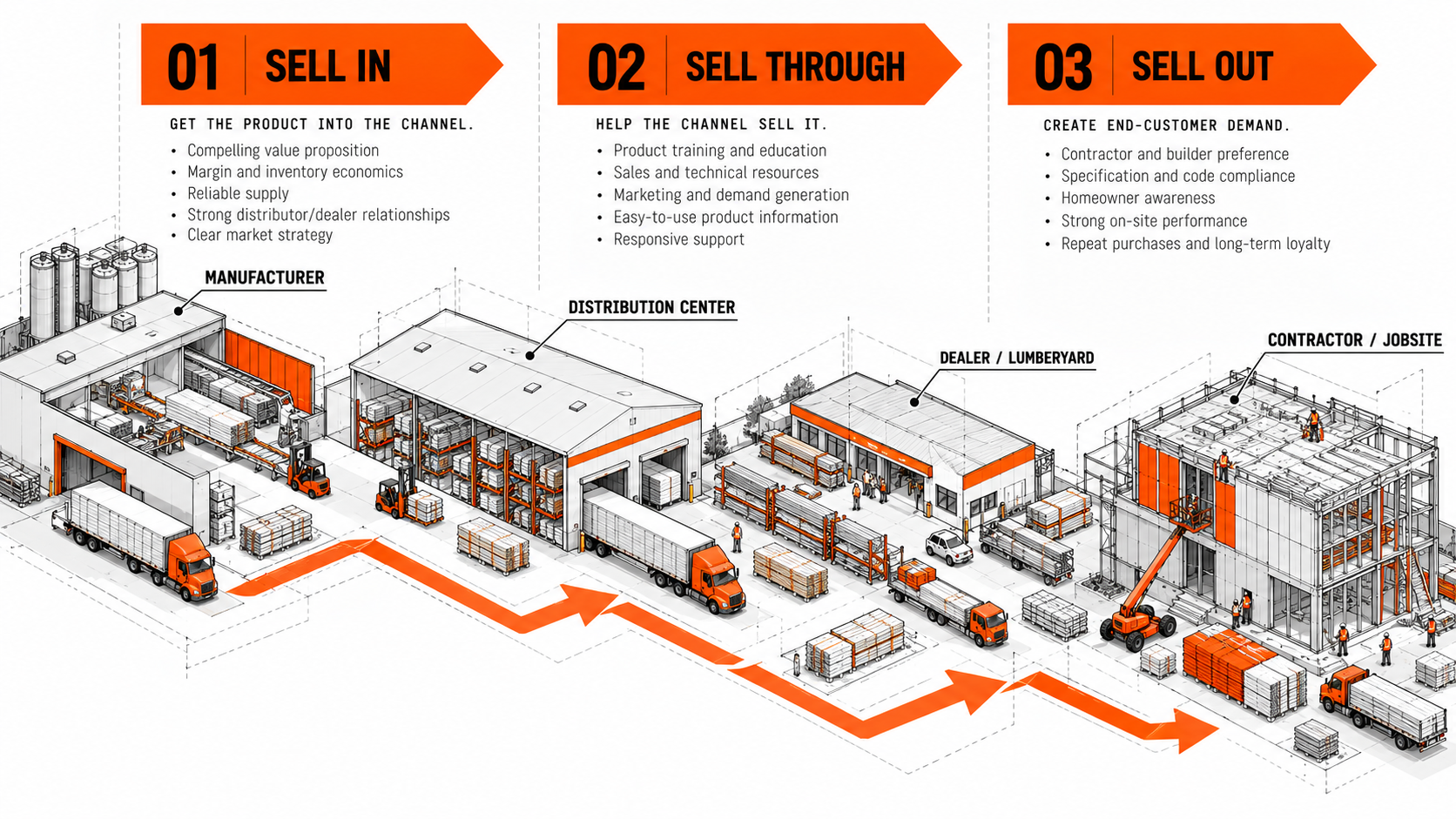
That means manufacturers need to think beyond the initial sale into distribution. A useful framework is: SELL IN > SELL THROUGH > SELL OUT
Each stage requires something different from the manufacturer.
Sell in means earning the distributor or dealer's commitment to stock the product.
Sell through means helping their sales organization understand, position and recommend it.
Sell out means creating enough contractor, builder, architect or homeowner demand that the product actually moves.
Many manufacturers invest heavily in the first step and assume the other two will take care of themselves. That’s a mistake.
1. Start by understanding how your channel makes money
Manufacturers naturally view the relationship through their own economics.
How many units can we sell?
What volume can this distributor move?
What margin do we need?
How much market coverage can they give us?
The dealer is looking at another set of economics.
How quickly will the product turn?
How much inventory do we need to carry?
What margin does it generate?
How much space will it occupy?
How difficult is it to sell?
How often will customers return it?
Will the manufacturer support us when something goes wrong?
Those questions fundamentally change what constitutes an attractive product line.
A product with strong gross margin but slow inventory turns may not be particularly attractive. Neither is a product that requires a dealer salesperson to spend 30 minutes explaining it every time a contractor walks through the door.
Manufacturers therefore need to understand the channel economics surrounding the product, not just the manufacturer's economics of selling it.
That's particularly important as distributors get larger and more sophisticated. Consolidation across the industry is creating organizations with greater purchasing power, broader geographic reach and increasingly complex product portfolios. QXO's expansion is one obvious example: after acquiring Beacon in 2025 and Kodiak Building Partners in 2026, it announced a roughly $17 billion deal for TopBuild, which would create a combined business with more than $18 billion in revenue.
Scale changes the conversation.
When your channel partners have more products, locations, data and purchasing leverage, manufacturers have to make a stronger case for why their line deserves attention.
2. Reliable supply is part of your value proposition
If the last several years taught the building products industry anything, it's that availability matters. But reliability means more than avoiding catastrophic supply-chain disruptions.
Dealers are constantly balancing inventory against demand. Too little inventory creates stockouts and lost sales. Too much ties up working capital, consumes warehouse space and increases the risk of carrying products that don't move.
Manufacturers can make that job easier or harder.
Accurate lead times help. Good forecasting helps. Clear communication helps. Regional inventory helps. Consistent fill rates help. So does giving the channel visibility when something changes rather than forcing dealers to discover it after an order has already been placed.
Current trade uncertainty makes that even more relevant. In September, the National Lumber and Building Material Dealers Association was collecting dealer feedback on how new tariffs on Canadian imports were affecting costs, product availability and sourcing, including the difficulty of changing established vendor relationships.
Manufacturers can't eliminate every disruption. They can become the supplier dealers trust to communicate clearly and respond when disruption happens. There's real brand value in that.
3. Your dealer salesperson is probably selling a lot more than your product
Spend enough time inside a manufacturer and it's easy to develop tunnel vision. Your category is incredibly important to you.
But you have to realize that it may only represent 2% of the dealer salesperson's day.
That salesperson might be responsible for dozens of categories and hundreds or thousands of individual products. They're answering contractor questions, building quotes, checking availability, solving delivery issues and trying to remember the difference between your newest product and the three competitive products sitting next to it.
Giving them a 48-slide product presentation isn't sales enablement. The goal should be to make your product easy to understand, easy to explain and easy to recommend.
What problem does it solve?
Who is it right for?
Why would a contractor choose it?
When should they recommend it instead of another option?
What are the two or three meaningful differences?
What objection are they most likely to hear?
Where can they quickly find additional information?
If a salesperson can confidently answer those questions, you've accomplished far more than you would by asking them to memorize every feature.
Manufacturers sometimes complain that dealers aren't telling their story correctly. Before blaming the dealer, make sure you've made the story easy to tell.
4. Help dealers serve the contractor
One of the best ways manufacturers can create value for the channel is by helping the channel create value for its customers. For many building supply dealers and distributors, that customer is the professional contractor. Those pros don't simply need materials. They need products available when the job requires them, quick answers, accurate orders and suppliers who help keep projects moving.
That creates an important connection between this article and the contractor conversation from the previous Workbench post. If contractors value performance, installation, availability, support and profitability, manufacturers should give their channel partners the tools to deliver those things.
That might include better product training, jobsite support, installation resources, technical documentation, samples, estimating tools, merchandising, local inventory programs or knowledgeable manufacturer reps who can help solve difficult problems.
The manufacturer shouldn't be trying to replace the dealer relationship — it should be helping make that relationship stronger. That's an important mindset shift.
Instead of asking How can our dealer sell more of our product?, ask: How can our product and support help the dealer become more valuable to their customer?
If you can answer that well, the first question tends to become easier.
5. Don't make the channel responsible for creating all the demand
There's a fundamental difference between distribution and demand. Getting a product onto the shelf, into the yard or inside a distribution center solves the distribution problem.
While product availability is a factor, it doesn't automatically create a reason for someone to buy it.
Yet manufacturers sometimes celebrate gaining distribution as though the marketing work is finished. They sign a new partner, announce expanded availability and wait for sales to follow.
Then six months later, everyone wonders why the product isn't moving (or is moving too slow).
The channel shouldn't have to create your market for you.
Manufacturers need to generate demand among the audiences that ultimately influence product selection. Depending on the category, that might mean architects specifying the product, builders standardizing it, contractors requesting it or homeowners asking for it.
This is where the building products customer journey becomes particularly important.
A manufacturer may sell to a distributor that sells to a dealer that sells to a contractor who installs a product selected by a homeowner or specified by an architect. That's a lot of influence between the factory and the finished building.
Good channel marketing recognizes that reality.
6. Think locally, even when your channel is national
Industry consolidation can make building products distribution look increasingly national from a manufacturer's perspective. But the market itself remains remarkably local.
Building practices differ. Codes differ. Product preferences differ. Climate differs. Architectural styles differ. Competitive brands differ. Contractor relationships differ.
Even demand conditions can vary substantially by geography. August housing data, for example, showed single-family starts rising sharply month over month in the Midwest and West while the broader national construction environment remained cautious.
A national distribution agreement doesn't erase those differences.
Manufacturers need to understand where the product has the strongest fit, where the dealer already has customer relationships, which competitive products dominate locally and what kind of support will actually move the market. That can mean concentrating marketing resources rather than spreading them evenly across every branch.
If you have 500 locations carrying the product but only 75 markets with strong demand potential, treating every location identically probably isn't the best use of your budget. This is where the 80/20 (the Pareto Principle) can help add focus.
Distribution gives you access to the market, while local activation helps you win it.
7. Digital tools should remove friction, not simply check a box
Technology is becoming increasingly important across building products distribution, but manufacturers should resist the temptation to treat digital transformation as an objective by itself.
The better question is: what friction can technology remove?
Can a contractor see whether a product is available before driving to the dealer?
Can a salesperson quickly access technical documentation?
Can a customer configure the right system without sorting through ten PDFs?
Can a dealer see order status without calling customer service?
Can product data flow accurately into distributor websites and ecommerce systems?
Can a manufacturer understand which products are gaining traction by region or customer segment?
Those capabilities aren't exciting because they're digital. They're valuable because they make buying and selling easier.
The industry is paying more attention to this intersection of technology and distribution. HBSDealer's 2026 coverage has repeatedly highlighted technology, AI, logistics and operational efficiency as competitive issues for dealers facing larger competitors and shifting customer expectations.
Manufacturers should think about their role in that ecosystem.
If your product data is inconsistent, your digital assets are difficult to access or your systems make basic transactions harder, you're transferring work downstream to your channel partner. That's not value creation; it's friction.
8. Independent dealers still matter
Consolidation makes headlines because the numbers are enormous. But it would be a mistake for manufacturers to assume the future of the channel belongs exclusively to a handful of national distributors.
Independent dealers and distributors continue to have meaningful advantages: local relationships, market knowledge, speed, specialization and the ability to serve customers in ways that don't always scale neatly across a national organization.
The independent distribution network remains substantial. The Associated Building Material Distributors of America, for example, reported in September that its 40 member companies operate more than 285 distribution centers with collective annual revenue exceeding $10 billion.
Those businesses can be incredibly important partners for manufacturers, particularly in categories where product knowledge, contractor relationships or local market expertise strongly influence the sale.
But independent dealers face many of the same pressures as their larger competitors. That means manufacturers need to understand where they can help level the playing field.
Strong digital assets, training, marketing programs, leads, merchandising, product expertise and reliable supply can give smaller partners capabilities they might struggle to build independently.
The relationship becomes more valuable when the manufacturer isn't simply another vendor asking for shelf space.
9. Measure sell-through, not just sell-in
One of the easiest ways for manufacturers to fool themselves is by looking only at what they've sold into the channel.
A large initial order feels good. It isn't necessarily demand. The more useful question is what happens next.
Is inventory moving?
Which branches are performing?
Which customer segments are buying?
Are contractors purchasing again?
Are certain SKUs turning while others sit?
Are promotions creating sustainable demand or simply pulling orders forward?
Where are dealers asking for more support?
Where is the product consistently losing to a competitor?
Those are marketing questions as much as sales questions. Manufacturers that have access to sell-through data should use it aggressively. Those that don't should look for other signals through distributor conversations, dealer councils, rep feedback, contractor research and market-level sales analysis.
Because the objective isn't to ship product to a warehouse. It's creating enough value throughout the channel that somebody eventually purchases and installs it.
From vendor to growth partner
If I were evaluating a manufacturer's channel strategy, I'd look at it through three stages.
SELL IN: Why should the dealer carry it?
Margin. Inventory economics. Product differentiation. Reliable supply. Market opportunity.
SELL THROUGH: Why should their team recommend it?
Simple positioning. Training. Sales tools. Technical support. Confidence in the product and manufacturer.
SELL OUT: Why should the customer ask for or choose it?
Demand generation. Contractor preference. Specification. Builder adoption. Homeowner awareness.
A strong distribution strategy connects all three. Too many manufacturers focus primarily on the first, provide a collection of brochures for the second and hope the third somehow happens.
That isn't really channel strategy; it's just product placement.
Winning in distribution requires more than distribution
The building products channel is changing rapidly, and there probably isn't a single distribution model that will define what comes next.
Large distributors will continue looking for scale. Independent dealers will keep competing through relationships, specialization and service. Manufacturers will reconsider partnerships, product portfolios and market coverage. Technology will make some transactions easier while the human relationships behind the channel remain incredibly important.
LP Building Solutions' September decision to restructure distribution for its SmartSide portfolio is a good example of how fluid the environment has become. Its new model combines nationwide coverage from Specialty Building Products with a network of regional distribution partners, including both existing and new relationships.
For manufacturers, the answer isn't simply to find the biggest distributor or add the most dealer locations.
It's to become more valuable to the partners that connect your products to the market. Understand their economics. Make your products easy to sell. Generate demand. Support their customers. Reduce friction. Give their people reasons to recommend you.
Because getting into the channel gives you an opportunity to compete. Helping the channel succeed gives you a reason to win.
Frequently Asked Questions
-
Building material dealers generally need products they can sell profitably, source reliably and support without unnecessary complexity. Strong manufacturers also provide effective training, sales tools, technical resources, demand generation and responsive support that helps the dealer better serve contractors and other customers.
-
Sell-in measures product moving from the manufacturer into a distributor or dealer. Sell-through measures whether that inventory is subsequently purchased by customers. Strong channel strategies focus on both because a large dealer order does not necessarily indicate sustainable market demand.
-
Manufacturers can help by simplifying product positioning, training dealer sales teams, providing useful technical and sales resources, generating downstream demand, maintaining reliable availability and supporting difficult customer or jobsite situations.
-
Consolidation is creating larger distributors with broader geographic footprints, expanded product portfolios and greater purchasing scale. At the same time, independent dealers continue to compete through local relationships, specialization, service and market knowledge. Recent major acquisitions and changing manufacturer distribution strategies illustrate how quickly the channel continues to evolve.
-
Many building products reach the market through multiple intermediaries rather than being sold directly to the end user. Channel marketing helps manufacturers create preference and demand throughout that system while giving distributors, dealers and their sales teams the tools they need to convert that demand into sales.