How Homeowners Choose Building Products — and Who Really Influences the Decision | Marketer Craft | Kyle Rhine
Building product manufacturers spend a lot of time trying to understand homeowners.
What motivates them? What features do they value? Where do they research products? How much are they willing to spend? What makes them choose one brand over another?
Those are important questions, particularly for manufacturers selling products that homeowners can see, touch or experience. But there's a problem with looking at the homeowner's decision in isolation.
The homeowner isn't always the person making the product decision.
A homeowner might spend weeks researching replacement windows, only to have their contractor recommend a different manufacturer becasue that’s the brand they carry. They may fall in love with a particular roofing product but discover their preferred installer doesn't offer it. They might specify a premium kitchen fixture during a renovation, only to learn that the builder's standard package includes another brand.
And sometimes, the homeowner doesn't know or care which brand is being installed at all, especially for less aesthetic or commodity products.
That's what makes marketing building products so interesting. Manufacturers aren't simply competing for the attention of an end consumer. They're competing for influence across a network of people who have different priorities, different levels of expertise and different roles in the purchase.
For manufacturers, the challenge isn't just understanding how homeowners choose products. It's understanding who actually influences the choice, when that influence happens and what each person needs to make a decision.
How do homeowners choose building products?
Homeowners typically evaluate building products based on some combination of price, appearance, performance, durability, brand familiarity, recommendations and confidence in the purchase. The importance of each factor varies by product category, project type, budget and the homeowner's level of involvement.
But the decision rarely happens in isolation.
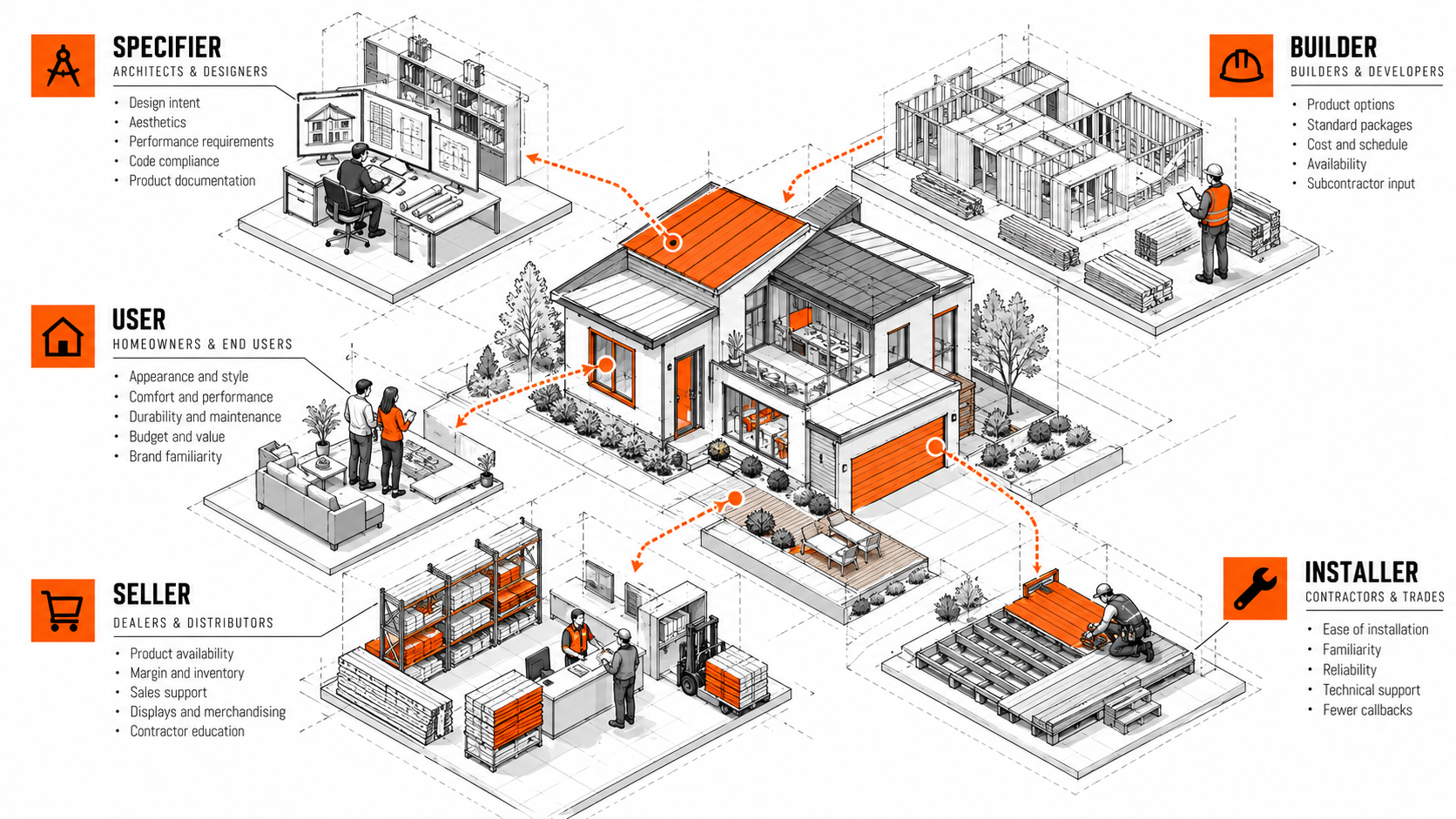
An architect may establish the product requirements. A builder may determine which manufacturers are offered as standard options. A contractor may recommend a brand based on installation experience. A dealer may influence availability and present alternatives. And the homeowner may have varying degrees of influence over the final selection.
In other words, the customer journey isn't always a straight line from awareness to purchase. Sometimes it's a series of conversations, recommendations and decisions happening between people who don't share the same priorities.
That's why building product manufacturers need to think beyond traditional consumer marketing and understand the larger decision-making system.
1. Understand the difference between the user, buyer, specifier and installer
One of the biggest mistakes manufacturers can make is assuming that everyone involved in a purchase is motivated by the same things.
Consider a homeowner replacing their windows.
The homeowner may care most about appearance, comfort, energy efficiency and the total project cost. The contractor may prioritize installation efficiency, product availability, reliability and the likelihood of callbacks to address issues. The dealer may care about inventory, margin and ease of doing business with the brand. If an architect is involved, they may be evaluating performance requirements, design intent, code compliance and technical documentation.
They're all evaluating the same product, but they’re evaluating it through completely different lenses.
This distinction becomes even more important in new construction, where the homeowner may have limited involvement in product selection. A production builder might have already established preferred manufacturers for dozens of product categories long before a buyer enters the model home.
The homeowner gets to choose between the options they're offered, but someone else has already narrowed the selecton.
For manufacturers, that means the audience you need to influence depends heavily on where your product sits in the decision process.
A brand competing for homeowner preference in decorative plumbing fixtures may need a very different marketing strategy than a manufacturer of housewrap, structural connectors or insulation.
The first question shouldn't be who uses our product; it should be who determines whether our product gets used.
2. Product visibility changes the marketing equation
Not every building product needs the same level of consumer awareness either. Some products are highly visible and central to how a homeowner experiences a space. Flooring, cabinetry, windows, doors, decking, siding and plumbing fixtures can influence the appearance, comfort and perceived value of a home.
Other products are largely invisible once construction is complete.
The homeowner may never see the flashing behind their siding, the waterproofing beneath their tile, or the structural fasteners holding parts of their home together.
That doesn't mean those products are less important. In many cases, they're essential to the building's performance. But the marketing challenge is different.
For visible products, homeowner preference can be a powerful driver of demand. A consumer who walks into a showroom already asking for a particular brand creates an advantage for the manufacturer.
For less visible products, the recommendation of a contractor, builder or architect carries considerably more weight than consumer brand recognition.
Manufacturers need to be realistic about where homeowner awareness creates value and where their resources would be better invested in professional audiences.
There's nothing wrong with building a consumer brand for a product homeowners rarely think about. But it needs to serve a clear business purpose.
3. Homeowners don't necessarily want more information — they want more confidence.
Manufacturers often assume that better-informed customers will make better purchasing decisions. That's generally true, but it overlooks an important distinction between information and confidence.
Most homeowners researching a new roof don't necessarily want to become experts in shingle construction, underlayment systems, ventilation requirements and installation techniques. They want to understand whether they're making a good investment and whether the roof will perform as expected for the next 30+ years.
The same applies to windows, siding, insulation, flooring and most other building product categories. Homeowners want enough information to feel confident in their decision without having to master the technical details of the category.
This creates an opportunity for manufacturers to simplify complex product information without oversimplifying the product itself. Instead of leading with technical specifications, explain what those specifications mean in practical terms.
How will the product affect comfort?
Will it require less maintenance?
How long should it last?
What makes it different from a less expensive alternative?
What happens if something goes wrong?
Why should the homeowner trust the recommendation?
Those are the questions that help people move forward.
Technical information still matters, especially when homeowners want to investigate further. But the first job of consumer-facing marketing is often to make the decision feel understandable.
Knowledge builds confidence, and confidence makes decisions easier.
4. Professional recommendations can outweigh consumer preference
One of the most important influences on homeowner product selection is the recommendation of someone they trust. That might be a contractor, builder, architect, designer or salesperson at a local dealer.
The reason is fairly simple: homeowners don't purchase most building products frequently enough to develop meaningful expertise.
A homeowner might replace their siding once in 25 years. A siding contractor could install thousands of squares in a single year. A homeowner may purchase new windows once or twice in their lifetime, while a window dealer or installer has experience with hundreds of projects.
That difference in experience gives professionals considerable influence, and for good reason.
They understand how products perform in the field, which manufacturers provide dependable support, what installation challenges exist and where customers tend to experience problems.
But there's an important implication for manufacturers.
If your marketing creates homeowner demand for a product that the contractor doesn't trust, doesn't understand or doesn't want to install, you've created friction in the decision process.
The homeowner might ask for your brand, but the contractor may recommend something else. That doesn't necessarily mean your consumer marketing failed. It means your channel strategy wasn't fully aligned with the customer journey.
The strongest building product brands create preference among homeowners while also giving professionals a compelling reason to recommend the product.
Those efforts should reinforce each other rather than compete.
5. Price matters, but value needs to be understood
Affordability continues to influence decisions throughout the housing market, and homeowners are making difficult tradeoffs between what they want and what they can reasonably spend. That creates pressure for manufacturers selling premium products.
When budgets tighten, features that once seemed desirable can quickly become optional. Homeowners may choose a less expensive material, postpone part of a renovation or eliminate upgrades that don't appear to justify their cost.
Manufacturers sometimes respond by emphasizing discounts, promotions or financing. Those tools can help, but they don't necessarily solve the underlying challenge.
If the homeowner doesn't understand why one product costs more than another, the cheaper option will often look like the better value.
That's why manufacturers need to connect product benefits to outcomes homeowners actually care about.
A premium window isn't simply a collection of performance ratings. It may contribute to greater comfort, reduced outside noise, improved aesthetics or lower energy consumption under the right conditions.
A more expensive decking product isn't just a different material. It may offer a particular appearance, reduced maintenance requirements, stay cooler in the sun or have a longer useful life.
A premium roofing system might provide better durability, stronger warranty coverage or greater resistance to certain weather conditions.
The key is making those differences meaningful and supporting the claims with evidence.
Value isn't what the manufacturer says the product is worth — it's what the customer believes the benefits are worth.
And that perception is shaped by far more than the product itself.
6. Understand when the homeowner enters the decision
One of the most useful exercises a building product marketer can do is map the decision process for a specific product category.
When does the homeowner first become aware that they need the product?
When do they begin researching options?
At what point do they contact a professional?
Who presents the available choices?
When does the product category become part of a larger project estimate?
Who makes the final recommendation?
And perhaps most importantly, when does the decision become difficult to change?
That last question matters because manufacturers can spend significant resources influencing someone after the meaningful decision has already been made.
Consider a homeowner building a new home with a production builder. The homeowner may begin researching flooring options after signing a contract, but the builder may have established supplier agreements, standard product packages and upgrade options months or years earlier.
By the time the homeowner begins shopping, the manufacturer's opportunity to become part of the project may already be limited.
A replacement project can work differently. The homeowner may begin with online research, compare brands, read reviews and develop preferences before ever speaking with a contractor.
Those are two very different customer journeys and they require different marketing strategies.
Manufacturers that understand the timing of influence can invest in the audiences and touchpoints most likely to affect the final outcome.
7. Make it easier for professionals to communicate your value
If contractors, builders, designers and dealers influence homeowner decisions, manufacturers need to help those professionals explain their products.
That sounds obvious, but it's an area where building products marketing frequently becomes disconnected.
Manufacturers create technical product literature for professionals and lifestyle-oriented advertising for homeowners. Then they expect the person selling or recommending the product to somehow connect the two.
Sometimes that works, but often, it creates unnecessary complexity.
A dealer salesperson needs to explain the difference between product options in language the homeowner understands. A contractor needs to justify a recommendation without spending 20 minutes reviewing specifications. A builder's design center needs to communicate why an upgrade is worth considering.
Manufacturers should be giving those partners useful tools. That might include simple product comparisons, homeowner-facing benefit statements, project photography, samples, visualizers, installation videos, warranty explanations and content that addresses common objections.
The objective isn't to turn every professional into a marketing expert — it's to make the manufacturer's value proposition easy to communicate accurately and consistently.
When the professional can explain the product confidently, the homeowner is more likely to understand it. And when the homeowner understands the value, the professional has an easier time making the sale.
That's what effective channel marketing should accomplish.
8. Digital discovery matters, but it doesn't tell the whole story
Homeowners have more ways than ever to discover building products. Search engines, manufacturer websites, online reviews, social media, video platforms, design inspiration sites and AI-powered tools can all influence the early stages of a project.
That makes a strong digital presence important. But manufacturers need to be careful about assuming that digital discovery equals purchase influence.
Someone might discover a product on Instagram, research it on the manufacturer's website, compare alternatives through search and eventually purchase a completely different brand because their contractor recommended it.
From the manufacturer's perspective, that could look like a failure to convert digital traffic.
From the customer's perspective, it may simply reflect how the category is purchased.
This is one reason building product marketers should be cautious about evaluating digital performance exclusively through direct conversions.
In complex purchase journeys, digital content may be building awareness, shaping preference, educating customers or helping them ask better questions when they speak with a professional. Those outcomes can be valuable even when the final transaction happens through a dealer, distributor or contractor.
The challenge is understanding how those interactions contribute to demand rather than expecting every digital touchpoint to behave like an ecommerce transaction.
9. Build a marketing strategy around influence, not just audiences
For building product manufacturers, I'd evaluate the customer journey through five roles.
THE USER: Who ultimately experiences the product?
Often the homeowner, although the product may also serve building occupants, tenants or other end users. Their priorities might include appearance, comfort, performance, durability and value.
THE BUYER: Who actually purchases the product?
That might be the homeowner, contractor, builder, dealer or distributor. Their priorities can include price, margin, availability, purchasing convenience and commercial terms.
THE SPECIFIER: Who establishes the product requirements or identifies acceptable options?
Architects, designers, engineers and builders may play this role. Their priorities often include technical performance, compliance, aesthetics, documentation and risk.
THE INSTALLER: Who has to work with the product?
Contractors and tradespeople care about installation efficiency, reliability, technical support, safety and callbacks.
THE SELLER: Who presents, recommends or makes the product available?
Dealers, distributors, showrooms, builders and sales professionals can influence the final choice through product knowledge, merchandising, recommendations and availability.
One person or organization may occupy several of these roles, and their relative influence will change by category. That's precisely why the distinction matters.
A manufacturer that markets to homeowners without understanding the rest of the decision-making system may generate interest that never translates into sales.
A manufacturer that focuses exclusively on professional audiences may miss opportunities to create valuable consumer demand and pull-through.
The goal isn't to choose one audience over another — it's to understand how influence moves between them.
The homeowner matters. But so do the people they work with.
Building products marketing is rarely as simple as convincing one customer to choose one brand. That’s previsly what makes it so challenging.
A homeowner's preference can be shaped by online research, personal experience, budget, design inspiration, professional recommendations, product availability and the options they're ultimately presented with.
Some of those influences happen long before the homeowner starts shopping. Others happen at the kitchen table, in a showroom, at a lumberyard or even on the jobsite.
Manufacturers that understand those interactions can build more effective marketing strategies because they're no longer treating the customer journey as a single transaction. They're looking at the entire decision.
That means understanding who influences product selection, what each person values and when they have the opportunity to change the outcome.
Because in building products, winning the homeowner's attention is valuable. Understanding who influences their decision is how that attention becomes business.
Frequently Asked Questions
-
Homeowners typically evaluate building products based on price, appearance, performance, durability, maintenance requirements, brand familiarity and recommendations from trusted professionals. The importance of each factor depends on the product category, project type, budget and the homeowner's level of involvement in the selection process.
-
Depending on the project, architects, builders, contractors, designers, dealers and distributors can all influence product selection. Some establish technical requirements, others recommend specific brands and others control which products are available or offered to the homeowner.
-
Contractors often have substantially more experience with a product category than the homeowner. Their recommendations can carry weight because they understand installation requirements, reliability, manufacturer support and potential problems that homeowners may not recognize.
-
Direct-to-homeowner marketing can be valuable, especially for visible or experiential products where consumer preference can influence selection. However, manufacturers should also understand the professionals and channel partners involved in the purchase to ensure consumer demand can translate into product adoption and sales.
-
A B2B2C customer journey involves a manufacturer reaching the end consumer through one or more business intermediaries, such as distributors, dealers, builders or contractors. The manufacturer may need to influence several audiences before its product is ultimately purchased, installed and experienced by the homeowner.