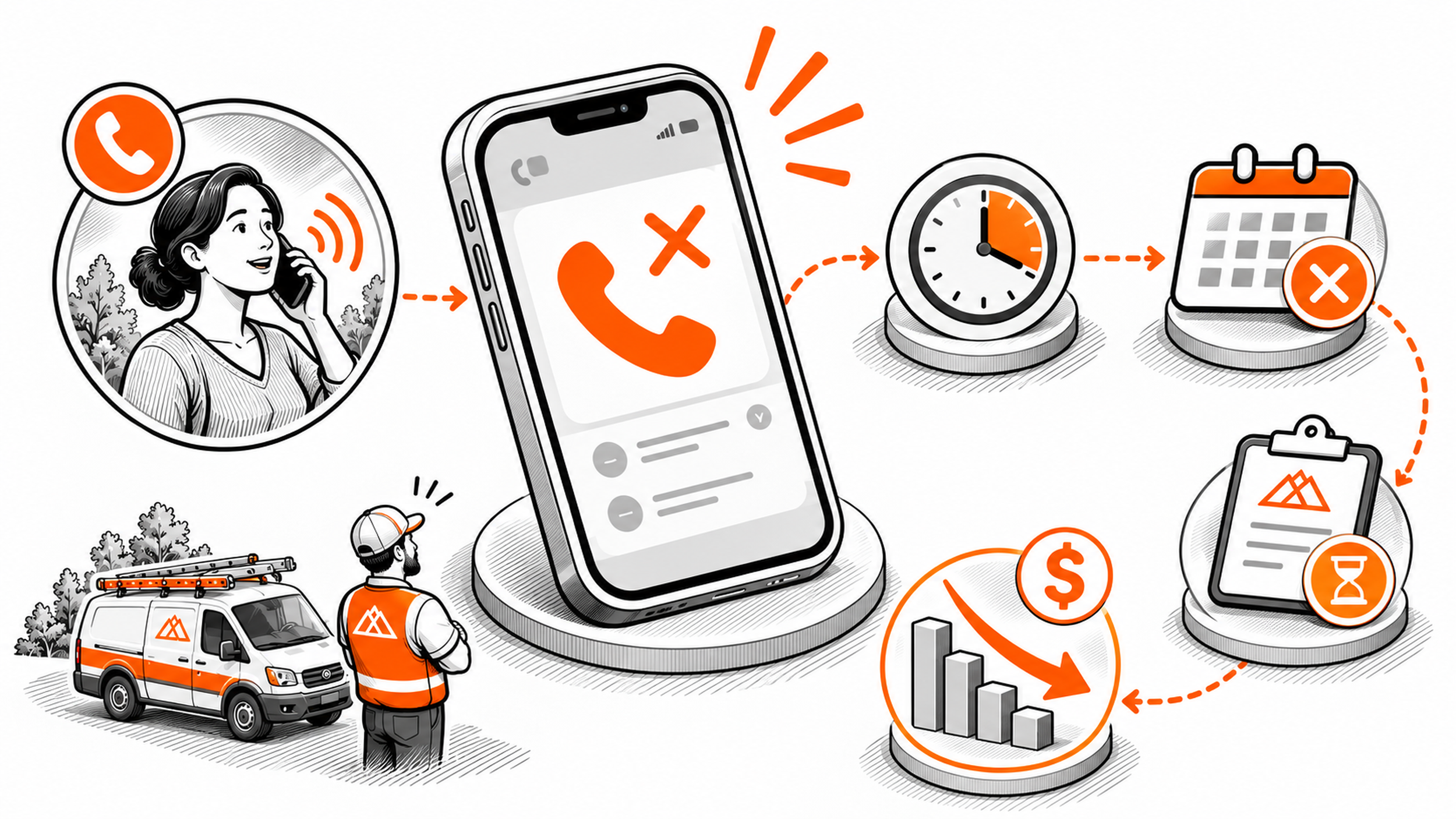
The True Cost of a Missed Call | Kyle Rhine | Marketer Craft
Why responding to customer leads may be one of the biggest growth opportunities hiding inside your home service business.
Most home service businesses spend a lot of time thinking about how to generate more leads. They invest in websites, Google Ads, social media, local SEO, and other marketing efforts designed to get their phones ringing.
But what happens when the phone actually rings?
If you're running a roofing, HVAC, landscaping, plumbing, or remodeling business, you know how difficult it can be to answer every call. You're meeting with customers, managing crews, preparing estimates, ordering materials, and trying to keep jobs moving. Sometimes the phone rings when you're on a ladder, underneath a sink, or in the middle of a conversation with another customer.
Missing a call isn't necessarily a sign that you're running your business poorly. It's often a consequence of running a busy operation with limited time and resources.
The problem is what happens next.
When a potential customer calls and can't reach you, they don't know how busy you are or how good your work is. They simply know they need help and haven't been able to get it. Depending on the urgency of their situation, they may leave a message, try again later, or move on to another provider.
And that means one of your biggest opportunities for growth might not be generating more leads. It might be doing a better job responding to the ones you already have.
Every Missed Call Represents a Potential Opportunity
Think about what it takes to get a prospective customer to contact your business.
Maybe they saw your truck in the neighborhood, found your website through Google, received a recommendation from a friend, or clicked on an advertisement. Whatever brought them to you, they've already taken an important step: they decided your business was worth contacting.
That doesn't mean every caller is a qualified lead. Some may be existing customers, vendors, or people looking for services you don't offer. Others may be comparing prices or researching projects they won't start for several months.
But when someone calls because they genuinely need your services, that inquiry has value. They've moved beyond simply learning about your business and expressed enough interest to reach out.
Now consider what happens when that person doesn't get an answer.
A homeowner with a leaking water heater might call several plumbers until someone can help. Someone planning a kitchen remodel may be willing to wait longer, but an unanswered call can still create doubt about how responsive the company will be once a project begins.
The urgency varies by service, but the underlying principle is the same: customers want to know that someone is paying attention.
For many home service businesses, responsiveness is one of the first demonstrations of customer service a prospective customer receives. It creates an early impression of how organized, dependable, and easy to work with your company might be.
You may do outstanding work once you arrive at the jobsite, but you have to earn the opportunity to get there.
What Is a Missed Call Actually Costing Your Business?
It's easy to dismiss an unanswered call as a minor inconvenience, particularly when you're already busy. But even a relatively small number of missed opportunities can represent meaningful potential revenue.
Let's look at a hypothetical HVAC company.
Suppose the business receives 200 inbound calls per month, and 20% go unanswered. That's 40 missed calls. If half of those calls are from legitimate prospective customers, the company has potentially missed 20 sales opportunities.
Now assume that, with timely follow-up, 50% of those prospects would schedule an appointment and 40% of those appointments would become paying jobs.
At an average job value of $1,000, those 20 opportunities represent approximately $4,000 in potential monthly revenue, or $48,000 over a year.
These numbers are illustrative, not industry averages or a prediction of what any specific company will recover. Actual results depend on the types of calls received, customer needs, scheduling capacity, close rates, job values, and how effectively missed inquiries are handled.
But the calculation reveals something important: Small breakdowns in your lead response process can add up to substantial missed revenue opportunities.
And if your company handles higher-value projects such as roofing, window replacement, or remodeling, even a few lost opportunities may have a significant financial impact.
Of course, revenue isn't profit, and recovering an opportunity still requires time, labor, materials, and operational capacity. That's why it's important to evaluate both the potential sales value and the actual contribution those jobs would make to your business.
The goal isn't to assume every unanswered call is a lost sale. It's to understand whether missed inquiries represent a problem worth addressing.
The Problem Isn't Always the Missed Call. It's What Happens Afterward.
Let's be realistic: Unless you have dedicated staff available around the clock, you're probably going to miss some calls.
That's especially true for small home service companies where the owner handles sales, scheduling, customer questions, and day-to-day operations.
Trying to answer every phone call personally isn't necessarily the solution. In fact, constantly interrupting customer meetings or service work to answer the phone can create an entirely different set of problems.
What matters is whether your business has a reliable process for responding when you can't answer.
Consider two contractors who miss a call while working with customers.
The first contractor notices the missed call several hours later, but by then the workday has gotten away from them. They plan to return the call tomorrow, forget, and eventually lose track of the inquiry.
The second contractor also misses the call, but the caller receives an acknowledgment explaining that the business is currently assisting another customer. The message provides a simple way to share what they need and lets them know when to expect a response. The inquiry is recorded, and someone follows up within the promised timeframe.
Neither contractor answered the original call, but the experiences are very different.
The second business has created a process that helps customers feel acknowledged and reduces the chance that an inquiry gets forgotten.
This is an important distinction because technology doesn't need to eliminate every missed call to create value. Sometimes the bigger improvement comes from making sure every legitimate inquiry receives an appropriate response.
Five Ways to Stop Losing Opportunities to Missed Calls
Improving how your business handles incoming leads doesn't have to involve hiring a receptionist or investing in an expensive call center. For many companies, a few practical changes can make the process more consistent and manageable.
1. Start by Understanding How Many Calls You're Missing
Before making changes, establish a baseline.
Most business phone systems can provide some level of call history, including incoming, answered, and missed calls. Review those records over several weeks and look for patterns.
Are calls being missed during particular hours? Do inquiries increase when crews are finishing their workday? Are customers calling after your office closes? Does one person receive most of the incoming calls, even when others are available to help?
It's also worth separating new customer inquiries from existing customer calls, vendors, spam, and other contacts. A raw missed-call count can be misleading if you don't understand who's calling and why.
Once you've identified the patterns, you can make better decisions about whether you need additional coverage, a different call-routing process, or a more reliable follow-up system.
2. Give Customers an Immediate Acknowledgment
When someone reaches out to your business, they want to know their inquiry was received.
An automated text message can help acknowledge a missed call, provided the system is configured appropriately and the customer has the necessary permissions to receive that communication. A simple message might say:
"Thanks for contacting [Business Name]. We're helping another customer right now, but we'd be happy to help. Please reply with your name and a brief description of what you need, and we'll follow up as soon as possible."
The message doesn't need to be clever or overly promotional. It should sound like something your business would naturally say.
More importantly, it should set an expectation you can actually meet. If you tell customers you'll respond within an hour, your team needs a process for making that happen.
Automated acknowledgments are useful, but they aren't a replacement for human follow-up. Their job is to bridge the gap until someone can take ownership of the conversation.
3. Make It Easy for Customers to Contact You in Different Ways
Not every homeowner wants to make a phone call, and not every question requires one.
Someone researching a new deck might prefer to submit a short website form, while a homeowner dealing with an active plumbing leak probably wants to speak with someone immediately.
Providing a few clear contact options can make your business more accessible without making the process complicated.
That might include a prominent phone number, a simple estimate request form, an email address for less urgent questions, or text messaging when your systems and customer permissions support it.
The important part is consistency. Adding more contact channels won't help if nobody monitors them.
Every method should connect to a process that ensures inquiries are reviewed, assigned, and answered.
4. Establish a Consistent Lead Follow-Up Process
A missed call isn't the only place where customer opportunities disappear. Inquiries can also get lost after the first conversation, particularly when estimates, scheduling, and customer communications are managed across multiple phones, inboxes, and notebooks.
A simple lead management process helps prevent that.
At a minimum, your business should know who contacted you, what service they need, when the inquiry arrived, who's responsible for responding, and what happens next.
For a smaller company, a shared spreadsheet or organized contact list may be sufficient. As volume grows, a customer relationship management system can help consolidate information, assign responsibilities, schedule reminders, and make it easier to see which opportunities still need attention.
The objective isn't to introduce more administrative work. It's to ensure that interested customers don't fall through the cracks simply because everyone is busy.
5. Use Technology to Support Your Team, Not Replace It
Automation can be valuable for home service businesses because many customer interactions are predictable.
Acknowledging an inquiry, confirming an appointment, reminding someone about an upcoming visit, or notifying a team member that a lead needs attention are all processes that can often be supported by technology.
But not every conversation should be automated.
A homeowner upset about a delayed project probably needs a personal response. Someone trying to understand a complicated estimate may benefit from speaking directly with an experienced team member. And customers dealing with urgent situations should have a clear path to appropriate assistance rather than being trapped in an automated conversation.
The best approach is to automate routine steps while making it easier for your people to handle the interactions that require judgment, empathy, and expertise.
Good technology should help your business become more responsive without making it feel less personal.
How to Calculate the Potential Cost of Missed Calls
You don't need sophisticated analytics to begin estimating the financial impact of missed calls. Start with the information you already have, make reasonable assumptions where necessary, and refine the numbers as you collect better data.
A useful calculation is:
Missed calls × Percentage of qualified leads × Appointment rate × Close rate × Average job value = Potential revenue opportunity
For example, if your business misses 30 calls per month, 60% are qualified leads, 50% of those would book an appointment, 40% of appointments would convert to jobs, and your average job value is $2,500, the estimated potential revenue is:
30 × 60% × 50% × 40% × $2,500 = $9,000 per month
That doesn't mean your business automatically loses $9,000 every month. Some of those callers may reach you later, some will choose another provider for reasons unrelated to response time, and others may never purchase.
Think of the calculation as a way to size the opportunity, not a precise measure of lost revenue.
For a better understanding of the actual impact, begin tracking how many missed inquiries you successfully recover, how many become appointments, and how many ultimately turn into paying customers.
Over time, those numbers can help you determine whether changes to your call-handling process are producing meaningful business results.
Before You Spend More on Advertising, Look at Your Lead Response
Marketing and operations are often treated as separate parts of a home service business. Marketing generates interest, while operations handles the work that follows.
But from the customer's perspective, there's no separation.
They don't distinguish between your Google Ads campaign, website, office staff, sales team, or service technicians. They experience one business, and every interaction contributes to their impression of it.
That's why a company can invest heavily in advertising and still struggle to generate consistent growth. If the process for handling inquiries is unreliable, increasing lead volume may simply create more opportunities for things to go wrong.
Before increasing your advertising budget, take a closer look at how efficiently your business handles the demand you're already generating.
Are calls being answered or returned promptly? Are website inquiries receiving appropriate responses? Do customers know what happens after they request an estimate? Is someone responsible for following up, and can you identify which inquiries eventually become paying jobs?
Fixing gaps in that process may improve the value of your existing marketing investments while helping customers feel more confident about doing business with you.
And once your lead response process is working consistently, additional marketing becomes easier to evaluate because you have a clearer understanding of what happens after customers contact you.
Better Growth Starts With Better Follow-Through
Running a home service business means balancing competing priorities, and answering every call isn't always realistic. There will be busy mornings, unexpected problems, demanding customers, and days when your schedule doesn't go according to plan.
But a busy operation shouldn't mean that interested customers are routinely forgotten.
The solution isn't necessarily to work longer hours or personally respond to every inquiry. It's to build a dependable process that acknowledges customers, captures their information, assigns responsibility, and follows through.
For some businesses, that may be as simple as improving phone coverage and setting aside time each day to return calls. For others, it may involve implementing a CRM, automated acknowledgments, call routing, or additional administrative support.
The right solution depends on your business, your customers, and the volume of inquiries you're managing.
What matters is recognizing that the experience begins the moment someone decides to contact you, not when your crew arrives to do the work.
Before investing more money to make your phone ring, make sure you're getting the most out of the calls you're already receiving.
Because every missed call is a potential missed opportunity—and every customer deserves a response.
Put Better Ideas to Work
Are missed calls, slow follow-up, or inconsistent customer communications costing your business opportunities?
Marketer Craft helps local home service businesses improve how they capture leads, respond to customers, and turn more inquiries into booked jobs.